
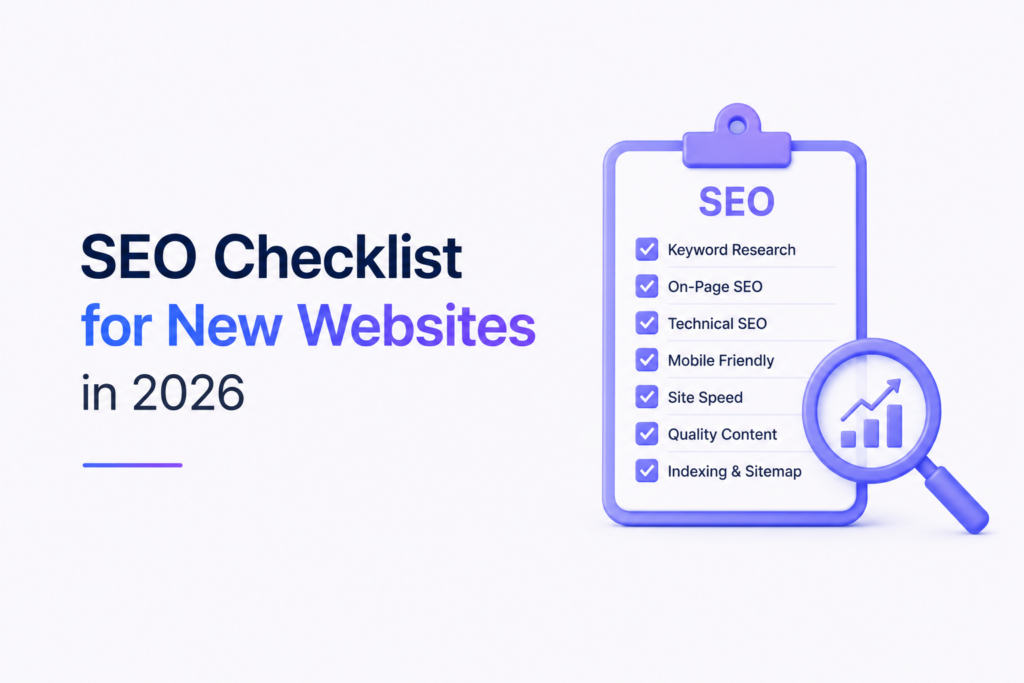
You’ve built your website, but without an SEO checklist you might as well be invisible to Google. This guide covers each step in the process of setting up technical SEO, on-page optimisation, local SEO, content strategy and post-launch audits so your new site starts ranking from day one in 2026.
93%
Of online experiences start with a search engine
75%
Of users never scroll past the first page of results
3 – 6
Months for a new site to gain SEO traction
Here is the thing nobody tells you when you launch a new website: Google does not care that you spent three months building it. Without a proper SEO checklist, even the most beautifully designed site will sit unnoticed on page 10 of the search results, collecting virtual dust.
Whether you are launching a job portal, a blog, an e-commerce store, or a service business website in 2026, the fundamentals of SEO have not changed. What has changed is how strictly Google enforces them. Core Web Vitals, AI-generated content detection, E-E-A-T (Experience, Expertise, Authoritativeness, Trustworthiness), the bar is higher than it has ever been.
This complete SEO checklist for new websites breaks everything down into manageable sections. Bookmark it, work through it systematically, and you will be miles ahead of competitors who treat SEO as an afterthought.
1. Technical SEO Checklist
Technical SEO is the foundation. Before writing a single blog post or targeting a keyword, your site needs to be crawlable, indexable, and fast. Think of it as building the roads before running cars on them.
Most new website owners skip technical SEO entirely and wonder why their site is not showing up on Google three months later. A solid technical SEO checklist prevents 80% of those problems before they happen.
| ⚙️ Technical SEO Checklist |
|---|
| Set up Google Search Console and verify your website ownership |
| Install Google Analytics 4 (GA4) for traffic monitoring |
| Enable HTTPS / SSL certificate; Google penalises HTTP sites |
| Create and submit an XML sitemap to Google Search Console |
| Set up a robots.txt file to control which pages get crawled |
| Ensure mobile responsiveness; Google uses mobile-first indexing |
| Optimize Core Web Vitals: LCP under 2.5s, CLS under 0.1, FID under 100ms |
| Implement canonical tags on duplicate or similar content pages |
| Fix any broken links (404 errors) using Google Search Console or Screaming Frog |
| Enable structured data / schema markup for rich results (Article, FAQ, Job Posting) |
| Compress all images and use WebP format to improve page speed |
| Set up 301 redirects for any changed or removed URLs |
The above technical SEO audit checklist is your starting point. Test it with Google PageSpeed Insights and Search Console every 3 months, not only on launch. Technical debt builds up quietly and can kill rankings without warning.
2. On-Page SEO Checklist
Most of the visible work is done on-page SEO. This is what Google reads to determine if your page deserves to rank for a given query. Each page of your website (not just the homepage) must be optimised individually.
Title Tags & Meta Descriptions
Your title tag is the most important on-page SEO factor. Must include your main keyword Less than 60 characters Must generate actual curiosity or clarity for the reader Your meta description (under 160 characters) does not directly impact rankings, but it dramatically affects click-through rates, which do impact rankings indirectly.
| 📝 On-Page SEO Checklist |
|---|
| Write a keyword-rich title tag under 60 characters for every page |
| Write a compelling meta description (under 160 characters) for each page |
| Use a single H1 tag containing the primary keyword on each page |
| Structure content with logical H2 and H3 subheadings using semantic keywords |
| Include keyword in the first 100 words of each page naturally |
| Add alt text to all images describing the image with relevant keywords |
| Use SEO-friendly URL slugs – short, keyword-rich, lowercase, hyphenated |
| Add internal links to related pages with minimum 2–3 per blog post |
| Include at least one external link to a credible authoritative source |
| Aim for content length of 1,500+ words for competitive informational keywords |
| Include LSI (Latent Semantic Indexing) keywords naturally throughout the content |
| Add an Open Graph image (1200×630px) for social sharing visibility |
The best on page SEO checklist is one you run before you publish every single piece of content, not just at setup. Get real-time on-page SEO scoring as you write using a plugin like Rank Math or Yoast.
3. Keyword Research Checklist
Keyword research isn’t just about the words people are searching for. It’s about finding the right words ones that have enough volume to matter and low enough competition for a new site to realistically rank. A new website should not compete against Semrush or Ahrefs on head terms from day one. Target long tail opportunities.
1 Define Your Core Topic Clusters
Start with 3-5 broad topics your site covers. Each becomes a “pillar page.” Sub-topics branch off as supporting blog posts, creating topical authority, which Google rewards heavily in 2026.
2 Find Long-Tail Keywords (KD under 30)
Use Semrush Keyword Magic Tool, Google’s “People Also Ask” box, or AnswerThePublic. Target 3-5 word phrases with 200-2,000 monthly searches. A new site can rank for these in 60-90 days.
3 Analyse Search Intent
Every keyword has an intent: informational (how to, what is), transactional (buy, hire, apply), or navigational. Match your content format to the intent. Google looks at the top 10 results to judge this.
4 Map One Keyword Per Page
Avoid “keyword cannibalization” where two pages compete for the same query. Each page should own one primary keyword. Use a simple Google Sheet to track keyword-to-URL mapping.
5 Prioritise by Opportunity Score
Multiply monthly volume by (100 – KD%). High-volume, low-KD keywords give the best ROI for new websites. The screenshot above shows “local seo checklist” (KD 15) and “technical seo audit checklist” (KD 22) as golden opportunities.
4. Content SEO Checklist
Content is still king in 2026, but only the right kind of content. Google’s Helpful Content algorithm now penalises thin, AI-generated fluff and rewards content that demonstrates first-hand experience, expertise, and genuine value. Here is what your content SEO checklist should look like:
| 📄 Content SEO Checklist |
|---|
| Publish a blog or resource section content is your primary traffic engine |
| Write content that genuinely answers search intent, not just keyword-stuffed filler |
| Demonstrate E-E-A-T: include author bios, cite sources, show expertise |
| Build topic clusters: one pillar page + 5–10 supporting articles per topic |
| Update old content every 6 months, freshness is a ranking signal |
| Add a FAQ section with structured schema markup to target featured snippets |
| Use multimedia content (images, infographics, videos) to increase dwell time |
Think of your content strategy as building a Wikipedia-like hub in your niche. The more your site comprehensively covers a topic, the more Google trusts it as an authoritative source and the higher every page on your site will rank.
5. Local SEO Checklist
If your website serves a specific city, state, or region, you are leaving significant traffic on the table by ignoring local SEO. Local SEO is one of the highest ROI investments a small business can make in 2026, especially with Google pushing local results above organic results for nearly every service-based query.
| 📍 Local SEO Checklist |
|---|
| Create and fully complete a Google Business Profile (formerly Google My Business) |
| Ensure NAP consistency (Name, Address, Phone) across your site and all directories |
| Add local schema markup (LocalBusiness type) to your homepage |
| Build local citations on platforms like JustDial, Sulekha, IndiaMART (for India) |
| Create location-specific landing pages if you serve multiple cities |
| Actively collect and respond to Google reviews, they are a local ranking factor |
| Use geo-targeted keywords like "SEO services in Surat" naturally in page content |
6. Off-Page SEO & Link Building Checklist
Off-page SEO is the stuff that happens off your website that tells Google you are an authority. Backlinks links from other sites to yours are still the most powerful ranking factor in 2026. Building a healthy link profile for new websites requires patience, but it pays massive dividends.
| 🔗 Off-Page SEO Checklist |
|---|
| Submit your site to Google Search Console and request indexing for key pages |
| Create and optimise social profiles (LinkedIn, Twitter/X, Facebook), they rank and pass brand signals |
| Write guest posts for niche-relevant blogs with a link back to your site |
| List your business in reputable directories (Clutch, G2, IndiaMART, Glassdoor for jobs) |
| Build HARO (Help a Reporter Out) links by answering journalist queries |
| Create shareable assets (infographics, statistics pages, tools) that attract natural backlinks |
7. SEO Audit Checklist (Post-Launch)
Your work does not end at launch. Running a regular SEO audit checklist is what separates websites that sustain rankings from those that see a brief spike and crash. A good audit catches issues before they become ranking disasters.
Just like Semrush, Ahrefs and other top players in the “seo checklist” arena, we recommend doing technical SEO audits at least once every quarter. New websites should do a monthly audit for the first 6 months.
| 🔍 SEO Audit Checklist |
|---|
| Check Google Search Console for crawl errors, coverage issues, and manual actions |
| Audit Core Web Vitals in Search Console's Experience report fixes any "Poor" URLs |
| Identify and fix duplicate content using canonical tags or 301 redirects |
| Run a backlink audit to identify and disavow toxic or spammy links |
| Check keyword rankings and identify pages that dropped, update content accordingly |
| Review site speed using Google PageSpeed Insights aim for 90+ score on mobile |
| Perform a content gap analysis, find keywords competitors rank for that you don't |
8. SEO Migration Checklist (If Redesigning or Moving)
If you are redesigning your website, changing your domain, or moving from HTTP to HTTPS, you need an SEO migration checklist to protect your existing rankings. A poorly executed migration can cause a site to lose up to 80% of its organic traffic overnight, a very real and common disaster.
| 🔄 SEO Migration Checklist |
|---|
| Export all current URLs and their rankings before making any changes |
| Create a 301 redirect map from every old URL to its new equivalent |
| Test the new site on a staging environment before going live |
| Update internal links to point to new URLs, do not rely on redirect chains |
| Submit the new sitemap in Google Search Console post-launch and request re-indexing |
| Monitor traffic and rankings daily for the first 4 weeks after migration |
Putting It All Together: Your 2026 SEO Launch Roadmap
An SEO checklist for a new website is not a one-time task, it is a living document. Think of it as the ongoing health check for your digital presence. Here is a simple timeline for how to approach it:
Week 1: Technical Foundation
SSL, GSC, GA4, sitemap, robots.txt, mobile responsiveness, Core Web Vitals baseline audit.
Week 2: On-Page & Content
Keyword research, title/meta for all pages, H1-H3 structure, schema markup, 3 pillar blog posts live.
Month 1: Local SEO & Off-Page
Google Business Profile, local citations, social profiles, first guest post, directory submissions.
Month 3: First Audit
Run full technical SEO audit checklist, check rankings, update content, identify new keyword opportunities.
Month 6: Scale
Scale content to 20+ posts, build 10+ quality backlinks, review Core Web Vitals, expand local SEO if applicable.
