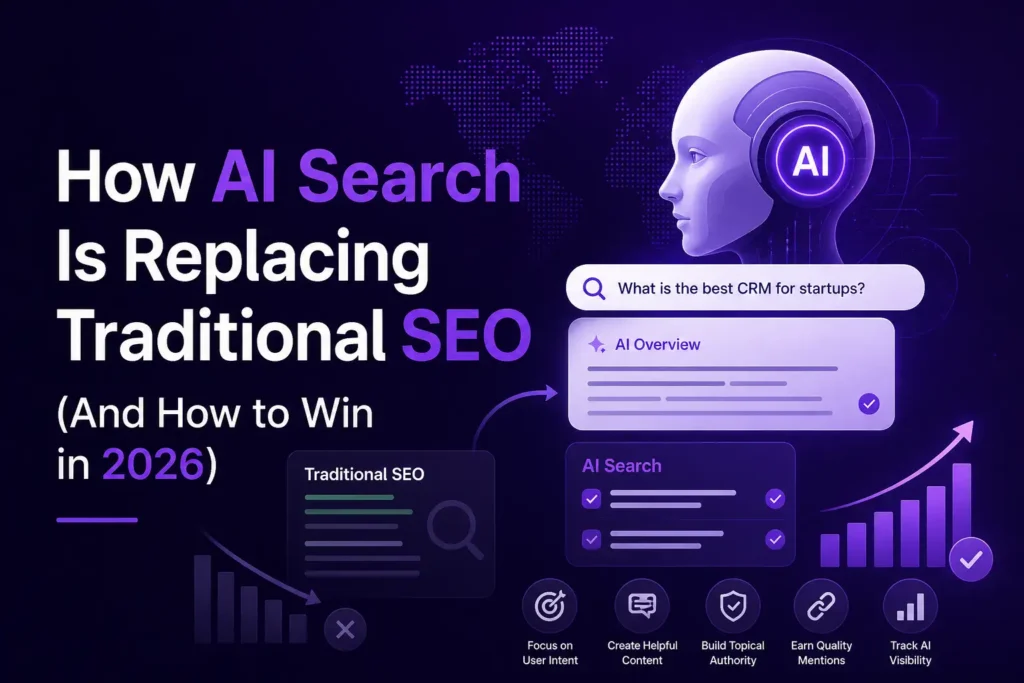
If your website traffic suddenly dropped in the last year, you’re not imagining it. AI search is eating the results page, and many businesses are still operating by rules from a decade ago. This guide explains what AI SEO actually means in 2026 and gives you an actionable playbook to win visibility in the new landscape.
What Is AI SEO?
AI SEO is the practice of optimizing your content, site structure, and digital authority so that AI-powered search engines including Google’s AI Overviews, Perplexity, ChatGPT Search, and Microsoft Copilot surface your brand in their generated answers.
Traditional SEO was about ranking in the blue links. AI SEO is about being cited in the answer itself. It’s a fundamental shift in how visibility is earned and it rewards different signals than what Google valued in 2015.
AI SEO is not a replacement for SEO. It’s an evolution. The brands that win in 2026 will be those that understand both the old rules and the new ones and know which ones still apply.
How AI Search Works (And Why It Changes Everything)
When someone searches on Google today, they often see an AI-generated summary at the top of the page before any organic listings. Google calls this the AI Overview. Perplexity and ChatGPT Search generate similar responses. These AI tools don’t “rank” pages, they synthesize them.
Here’s the core difference: a ranked result gives you a click if the user decides to visit. An AI Overview citation gives you authority and brand sometimes mention with a click, often without. This is why click-through rates have dropped across industries even as AI impressions rise. The game isn’t clicks alone anymore. It’s presence and citation in AI-generated content.
What signals does AI search use?
- E-E-A-T signals
- Structured data / schema
- Direct answer paragraphs
- FAQ sections
- Factual accurxacy
- Topical authority
- Backlink quality
- Entity clarity
- Content depth
- Source diversity
Traditional SEO vs. AI SEO: What's Different?
The table below compares the old playbook to what actually drives results in 2026:
| Area | Traditional SEO | AI SEO (2026) |
|---|---|---|
| Goal | Rank in blue links | Be cited in AI answers |
| Keyword focus | Exact match density | Semantic intent coverage |
| Content format | Long-form keyword stuffing | Direct answers + FAQ structure |
| Trust signals | PageRank / backlinks | E-E-A-T + entity authority |
| Measurement | Rankings & click-through rate | AI citations + brand mentions |
| Technical focus | Page speed, crawlability | Schema markup, structured data |
| Audience signal | Dwell time, bounce rate | Content expertise & depth |
How to Win with AI SEO in 2026: 5 Core Tactics
You don’t need to start from scratch. But you do need to evolve. These five tactics are what separates AI-visible brands from everyone else in 2026:
1. Write direct answer paragraphs
Open every article with a 2 – 3 sentence answer to the main query. AI engines prioritize content that answers immediately, not after a 400-word preamble.
2. Add FAQ schema markup
FAQ Page JSON-LD tells AI crawlers exactly where your Q&A content lives. It’s one of the fastest wins for AI citation placement available right now.
3. Build topical authority clusters
AI engines trust sites that deeply cover a topic, not sites with a single blog post. Pillar + cluster content architecture is now non-negotiable for AI SEO.
4. Demonstrate E-E-A-T explicitl
Include author bios, cite data sources, link to original research, and show credentials. AI systems extract trust signals from these markers before recommending your content.
5. Cover “People Also Ask” intentionally
Research PAA questions for every target keyword and build content that answers them. These are the exact prompts AI engines use to generate their summaries.
Real-World Example: What AI SEO Looks Like in Practice
Consider a B2B accounting software company targeting the keyword “best accounting software for small business.” Under traditional SEO, their goal was a top-3 ranking with optimized title tags and backlinks.
Under AI SEO, the goal changes: get cited in Google’s AI Overview when someone asks that query. To achieve that, the company rewrote their comparison page to open with a direct answer, added an FAQ section covering 12 common questions, implemented FAQPage and Product schema, and published supporting articles building topical authority around bookkeeping, invoicing, and payroll.
Result: organic clicks to that page dropped 18% as AI Overviews captured more queries but brand impressions doubled, leads increased 34%, and their content was cited in AI answers across Google, Perplexity, and ChatGPT Search. Less traffic, more revenue. That’s the paradox of AI SEO done right.
