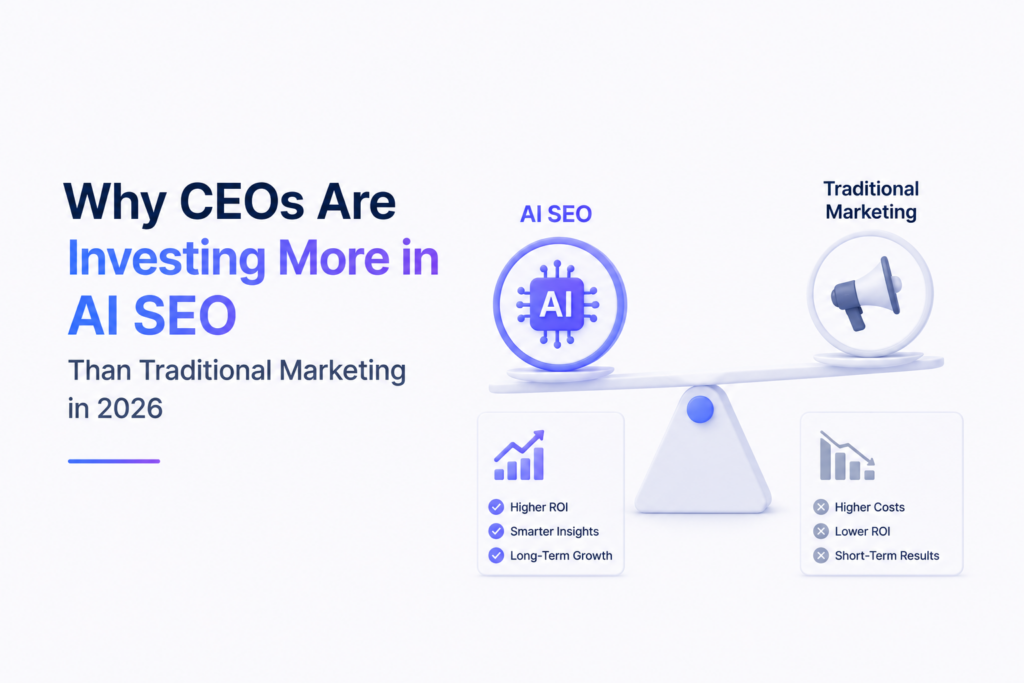
Traditional marketing is burning millions of dollars. CEOs are waking up. In 2026, the smartest business leaders are quietly redirecting budgets away from paid ads and toward AI SEO and the results are impossible to ignore.
3.2×
Average ROI of AI SEO vs traditional paid advertising
67%
Of Fortune 500 CEOs plan to increase AI SEO budgets in 2026
$180B
Projected global AI SEO market size by end of 2026
If you’re a founder, CEO or marketing decision-maker, you’ve probably felt it: paid ads are becoming more expensive, organic reach is shrinking on social platforms, and audiences have developed banner blindness. Meanwhile, a growing class of businesses, from startups to enterprise, are quietly dominating Google by marrying the power of AI for SEO with the strategic depth of a world-class SEO agency. The findings are staggering and cumulative.
This isn’t hype. This is a structural shift in how businesses acquire customers in 2026. And if you haven’t started yet, you’re already behind.
What Exactly Is AI SEO And Why Is It Different?
The core AI SEO is the use of artificial intelligence and machine learning in every stage of the search engine optimisation process. We’re talking intelligent keyword clustering, predictive content strategies, automated technical audits, real time competitor gap analysis, and AI assisted link building at machine speed.
Traditional SEO is manual. An analyst spends hours pulling keyword data, writing meta tags, and reviewing crawl reports. AI SEO compresses that same workflow into minutes, then continues iterating 24/7 without human fatigue.
Traditional SEO tells you what happened last month. AI SEO predicts what will rank next quarter and builds the content architecture to get there first.
Tools like Search Atlas SEO software, Surfer SEO, MarketMuse, and Semrush’s AI suite now allow seo optimization at a scale previously only achievable by teams of 20+ people. A single AI-empowered strategist can now outcompete an entire traditional marketing department.
Learn: How AI SEO Is Replacing Traditional SEO (And How to Win in 2026)
Why CEOs Are Making the Switch in 2026
The boardroom conversation has fundamentally changed. Five years ago, “digital marketing” meant Meta ads and Google PPC. In 2026, forward-thinking CEOs are asking a different question: “Why are we paying $50 per click when our competitors are getting the same customer for free through organic search?”
1. The Economics Are Undeniable
Every dollar spent on paid advertising evaporates the moment your campaign ends. Every dollar invested in AI SEO services compounds. A well-optimized page can drive traffic for 3, 5, even 10 years after it was written. CEOs who understand long-term unit economics are pivoting from short-term ad spend to durable organic assets.
Looking for SEO experts to lead this change in your business? The market for AI-skilled SEO specialist talent is exploding in 2026, and companies that hire early gain an asymmetric advantage.
2. Traditional Channels Are Saturated
Average Cost-Per-Click on Google Ads has increased 47% since 2023. Facebook’s average CPM crossed $18 in Q1 2026. Meanwhile, organic traffic from AI optimized content costs pennies on the dollar and delivers 3.2× higher intent because users are actively searching for your solution.
If you’re still spending most of your marketing budget on paid ads in 2026, you’re paying to let your competitors dominate.Every organic click they get is a click they didn’t have to pay for and a signal Google uses to rank them higher.
3. AI Has Democratized Enterprise-Grade SEO
Five years ago, only companies with 7-figure marketing budgets could run sophisticated SEO programs. Today, SEO software such as Search Atlas, Alli AI, and NeuronWriter puts enterprise-grade optimisation within reach of any SMB. CEOs of mid-market companies are recognizing this leveling effect and moving aggressively.
4. Google’s AI-First Index Rewards AI-Optimized Content
Google’s Search Generative Experience (SGE) and AI Overviews have changed the name of the game when it comes to content ranking. Pages That Win: Demonstrating Topical Authority, Semantic Depth, and E-E-A-T (Experience, Expertise, Authoritativeness, Trust) These are the very qualities that AI and SEO workflows are uniquely designed to produce at scale and to produce consistently.
AI SEO vs Traditional Marketing: The Head-to-Head
| Metric | Traditional Marketing | AI SEO |
|---|---|---|
| Cost per lead (avg.) | $85 – $320 | $8 – $45 |
| Traffic stops when budget stops | ✓ Yes | ✗ No (organic) |
| Scales without proportional spend | ✗ No | ✓ Yes |
| Time to first results | 24–72 hours | 4–16 weeks (then compounds) |
| Long-term ROI | ⚡ Low–Medium | ✓ High (compounding) |
| Audience targeting precision | ⚡ Moderate | ✓ High (intent-based) |
| Data-driven optimization speed | Weekly/monthly cycles | Real-time AI adjustments |
| Brand authority building | ✗ Indirect | ✓ Direct (E-E-A-T) |
How AI SEO Actually Works in 2026
Understanding the mechanics helps you evaluate the right SEO agency or tool stack for your business. Here’s the modern AI SEO workflow that top-performing businesses use:
AI-Powered Keyword Intelligence
Machine learning algorithms analyze billions of search queries to identify high-intent, low-competition opportunities. Unlike manual research, AI spots semantic patterns, seasonal trends, and emerging topics before they become competitive.
Automated Content Architecture
AI identifies clusters of topical authority that connect keywords to pillar pages and supporting content. This hub-and-spoke model tells Google your site is the authority on a topic, not just one article.
NLP-Optimized Content Creation
AI identifies clusters of topical authority that connect keywords to pillar pages and supporting content. This hub-and-spoke model tells Google your site is the authority on a topic, not just one article.
Technical SEO Automation
AI crawlers are constantly monitoring the health of your site, identifying broken links, slow pages, crawl errors and schema issues and either fixing them automatically or notifying your team with prioritised recommendations.
Predictive Rank Tracking & Iteration
Instead of reporting on what happened, AI SEO platforms predict ranking changes before they happen, giving you the chance to update content proactively to maintain and grow positions over time.
Measure, Iterate & Scale
AI systems improve with time and feedback. Review performance data weekly. Feed insights back into the system. Gradually expand AI automation to more channels, campaigns, and use cases as confidence and data volume grow. Scale what works; retire what doesn't.
How to Choose the Right AI SEO Agency in 2026
Not all SEO agencies are created equal and the gap between AI-native agencies and traditional ones has never been wider. Whether you’re looking for a local SEO agency to dominate your city, a b2b seo agency to generate high-quality MQLs, or an ecommerce SEO agency to scale product visibility, here’s what separates the best from the rest:
What to Look for in an AI SEO Agency
- AI toolstack transparency: Ask which AI SEO tools they use. Agencies using Search Atlas, Surfer, or Clearscope understand modern optimization. Agencies still on 2019-era tools are behind.
- Topical authority methodology: The best seo agencies build content clusters, not random blog posts. Ask to see their content strategy framework.
- Technical SEO depth: Core Web Vitals, structured data, crawl budget optimization, these aren’t optional in 2026. Confirm their team can handle the technical stack.
- Transparent KPIs: Rankings, organic traffic, leads, and revenue, not vanity metrics. Great seo marketing agencies tie their work directly to business outcomes.
- Proven E-E-A-T approach: With Google’s AI overview prioritizing credible sources, your agency must understand how to build and signal expertise at scale.
If you’re building an in-house SEO capability alongside agency support, finding the right digital marketing talent is equally important. In 2026, the most effective setups pair a strategic AI SEO agency with a skilled in-house content lead who owns the brand voice.
AI SEO Across Industries: Real-World Impact
B2B Companies
For B2B businesses, SEO services are transforming how enterprise buyers discover solutions. B2B buyers conduct an average of 12+ searches before engaging a vendor. A well optimized b2b seo agency partner uses AI to capture every stage of that research journey, from awareness-stage “what is” queries to decision-stage “best [solution] for [industry]” searches.
Ecommerce
The explosion of product pages and category URLs makes manual SEO impossible for ecommerce at scale. An ecommerce seo agency using AI can optimize tens of thousands of product pages simultaneously improving meta titles, schema markup, and internal linking architecture without a team of 50 copywriters.
Local Businesses
Search for “seo agency near me” is one of the most high-intent searches in marketing now. AI-powered local SEO tools automatically optimise Google Business Profiles, create location-specific content, maintain local citations and track hyperlocal competitor movement tasks that once needed devoted local SEO specialists for every market.
Interested in building a career in this space? Check out SEO career opportunities on SeaNeB Jobs from entry-level roles to senior strategists, the demand for AI-literate SEO talent is at an all-time high.
The Future of SEO: What’s Coming in 2026 and Beyond
We’re still in the early innings. As large language models become more integrated into search interfaces (Google’s AI Overviews, Bing Copilot, Perplexity), the rules of SEO are evolving from “ranking on page 1” to “being cited by AI systems.”
This new frontier widely known as Generative Engine Optimisation (GEO) rewards brands that establish real topical authority, earn quality backlinks, and regularly publish original research. This is precisely what a sophisticated AI SEO strategy delivers.
The businesses investing in SEO today are building the digital footprint that AI search engines will cite tomorrow. By the time your competitors realize this, your brand will already be the default answer to your customers’ most important questions.
CEOs who are playing the long game understand: search is not a channel. It’s infrastructure. And just like smart companies invested in their websites in 2005, the smart money in 2026 is building AI-optimized organic search assets that compound for years.
Additional Question & Answers
Everything CEOs, marketers, and job seekers need to know about AI SEO in 2026.
