
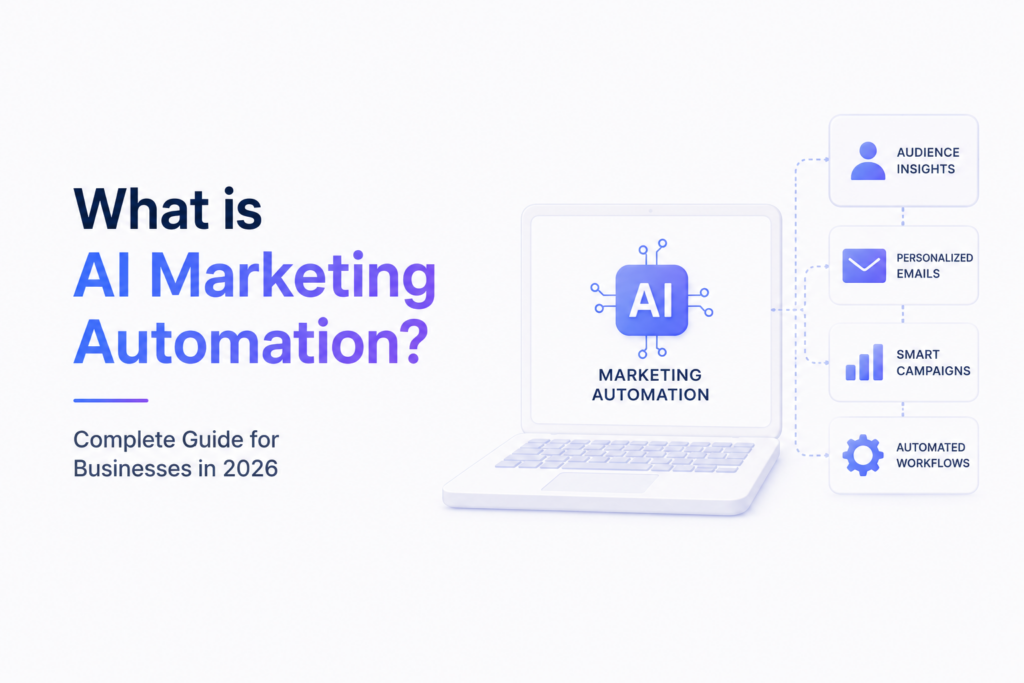
AI-powered marketing automation: all you need to know about predictive analytics to hyper-personalized campaigns, the tools that matter, and how to get started today.
What Is AI Marketing Automation?
AI marketing automation is the use of AI technologies like machine learning (ML), natural language processing (NLP) and predictive analytics to plan, execute, optimise and personalise marketing campaigns across multiple channels with minimal human intervention.
At its most basic, marketing automation is about removing manual repetition: scheduling emails, tagging leads, and posting on social media. AI takes this several steps further. Instead of simply executing pre-set rules, AI-powered marketing systems learn from data, predict what will happen next, and autonomously adjust strategy to achieve better outcomes.
AI marketing automation is the use of artificial intelligence to automate and intelligently optimise marketing activities such as audience segmentation, content personalisation, lead scoring, campaign management and performance analytics. It replaces static rules with dynamic, data-driven decision-making.
The Three Core Technologies Behind It
- Machine Learning (ML): Algorithms that improve through data exposure. In marketing, ML powers lead scoring models, recommendation engines, and churn prediction learning which audience segments respond to which messages, and when.
- Natural Language Processing (NLP): Enables computers to understand and generate human language. NLP drives chatbots, sentiment analysis, AI copywriting, and voice search optimization allowing brands to engage audiences at scale with contextually relevant language.
- Predictive Analytics: Uses historical data and ML to forecast future behaviors. Marketers use predictive analytics to identify high-value customers, forecast campaign performance, and pre-emptively personalize offers before a user even signals intent.
AI Marketing Automation vs. Traditional Marketing Automation
Understanding the difference between traditional and AI-powered automation is essential for making the right investment decision. They aren’t interchangeable; they solve fundamentally different problems at different scales.
Traditional marketing automation tools (think early HubSpot, Mailchimp, or Pardot) operate on rules you define. If a user downloads a guide, they enter a nurture sequence. If they visit a pricing page twice, a sales rep is notified. These workflows are powerful, but static. They can’t adapt unless you rewrite the rules.
AI marketing automation completely changes this model. Instead of “what rules do I set?”, you have “what goal do I want to achieve?” and the system figures out the optimal path.
| Aspect | Traditional Automation | AI Marketing Automation |
|---|---|---|
| Logic | Rule-based (If-Then) | Learning-based (Predictive & Probabilistic) |
| Data Usage | Triggers predefined workflows | Analyzes real-time data to create new workflows |
| Personalization | Segment-level (e.g., "all users in X industry") | 1-to-1 hyper-personalization based on behavior |
| Optimization | Manual A/B testing required | Continuous, autonomous A/B/n testing |
| Scalability | Limited by human bandwidth | Scales infinitely with data volume |
| Human Input | Constant setup & monitoring | Goal-setting & oversight only |
| Speed | Days to weeks for changes | Real-time adjustments |
| Cost Efficiency | High labor cost for optimization | Lower long-term cost with higher output |
An automated email sequence is not marketing automation AI. AI marketing automation is not about triggering pre-written emails after a time delay, but about systems that learn, adapt and make autonomous decisions.
Key Benefits of AI Marketing Automation for Businesses
Whether you’re running a startup, an SMB, or an enterprise marketing team, AI marketing automation delivers measurable advantages across every stage of the customer journey.
1. Hyper-Personalization at Scale
There’s traditional personalisation, which is just putting a first name into an email. AI-powered personalisation means dynamically changing the email subject line, email content, send time, product recommendation, and call-to-action based on an individual user’s behaviour, preferences, and predicted next action. On the scale. On millions of contacts simultaneously.
2. Predictive Lead Scoring
AI ranks every lead on hundreds of behavioural and firmographic signals to determine their likelihood to convert. Sales teams don’t waste time on cold leads they only focus on high-intent prospects AI has identified as ready to buy. This directly compresses sales cycles and increases revenue per rep.
3. Autonomous Campaign Optimization
AI-based platforms are constantly running multivariate experiments testing different subject lines, ad creatives, send times, landing page variations, and CTAs and automatically redirecting budget and traffic to the best performing combinations. No manual analysis needed. No waiting for the weekly reports.
4. Smarter Customer Segmentation
Instead of creating audience segments manually based on demographics, AI clusters customers using behavioral patterns, purchase history, engagement data, and predictive signals. These AI-generated segments are far more predictive of future behavior than traditional demographic slices.
5. 24/7 Customer Engagement via AI Chatbots
AI-enabled conversational marketing tools can chat with website visitors, qualify leads, answer product questions, and even book demo calls 24/7 without human agents. This provides a huge reduction in time-to-response and captures intent at the moment of intent.
6. Multi-Channel Orchestration
AI marketing automation platforms can handle customer journeys across email, SMS, social media, paid ads, push notifications and web personalisation at the same time. Every touchpoint is coordinated and consistent, delivering the right message on the right channel at the right time.
7. Data-Driven Attribution & ROI Clarity
One of the oldest problems in marketing is attribution. AI-powered analytics platforms use multi-touch attribution models to assign credit accurately to each marketing channel and touchpoint for its contribution to revenue, offering you real clarity on what to scale and what to cut.
Businesses implementing AI marketing automation consistently report reductions in cost-per-acquisition of 30–50%, alongside conversion rate improvements of 20–40%. The ROI is not theoretical, it is measurable and often visible within the first quarter of deployment.
Top AI Marketing Automation Use Cases in 2026
AI marketing automation isn’t a single capability; it’s an ecosystem of interconnected applications. Here are the most impactful use cases businesses are deploying right now.
AI Email Marketing Automation
Dynamic send-time optimization, subject line generation, content personalization, and behavioral trigger campaigns all managed autonomously by AI to maximize open rates and revenue per email.
Predictive Analytics & Forecasting
AI models forecast sales pipeline, customer lifetime value (CLV), churn risk, and campaign performance enabling proactive strategy adjustments before problems arise.
AI-Powered Ad Targeting & Bidding
Platforms like Google Ads and Meta automatically optimize audience targeting, bidding strategies, and creative selection using AI maximizing ROAS without manual intervention.
AI Content Generation at Scale
From blog outlines and ad copy to product descriptions and social posts AI content tools generate on-brand, SEO-optimized content in seconds, freeing creative teams for strategy.
Conversational Marketing & AI Chatbots
AI chatbots qualify leads, answer FAQs, book meetings, and guide buyers through the funnel 24/7, across website, WhatsApp, and social channels.
SEO & AEO Optimization
AI tools identify content gaps, generate semantic keyword clusters, and optimize for AI search engines (like Perplexity and Google AI Mode) expanding organic visibility beyond traditional SEO.
Social Media Automation
AI tools schedule, publish, analyze, and even generate responses on social media, including sentiment analysis of brand mentions and competitor intelligence reports.
E-Commerce Personalization
Product recommendation engines, dynamic pricing, abandoned cart recovery sequences, and personalized homepage experiences are all driven by AI behavioral models.
Best AI Marketing Automation Tools in 2026
The AI marketing software landscape has matured significantly. Choosing the right stack depends on your business size, primary use case, and technical capability. Here are the tools that are consistently delivering results.
HubSpot AI Marketing Hub
All-in-one CRM with AI-powered content creation, smart send timing, predictive lead scoring, and campaign orchestration. Best for mid-market to enterprise.
Salesforce Marketing Cloud + Einstein AI
Enterprise-grade platform with Einstein AI for journey personalization, predictive recommendations, and next-best-action intelligence across all channels.
Klaviyo
E-commerce focused AI email and SMS platform. Predictive CLV, AI-generated subject lines, dynamic product blocks, and segment-of-one personalization. Ideal for DTC brands.
ActiveCampaign
Powerful AI automation for SMBs. Predictive sending, win probability scoring, AI content generation, and cross-channel automation at accessible price points.
Jasper AI
Leading AI content generation platform for marketing teams. Creates on-brand blog posts, ad copy, product descriptions, and social content at scale with brand voice consistency.
Improvado
AI-powered marketing analytics and data pipeline platform. Unifies data from 500+ sources, automates reporting, and surfaces attribution insights across the full marketing mix.
Drift (Salesloft)
Conversational AI platform for B2B revenue teams. AI chatbots qualify website visitors, book meetings autonomously, and personalize the buyer experience in real time.
Sprout Social AI
AI-powered social media management. Optimal post timing, sentiment analysis, AI-generated captions, competitor benchmarking, and automated response workflows.
Google Ads Smart Campaigns + Performance Max
Google's AI automatically manages bidding, targeting, creative, and placement across Search, Display, YouTube, Gmail, and Shopping, maximising conversions for your budget.
How to Implement AI Marketing Automation: A Step-by-Step Framework
For businesses, successful AI marketing automation implementation isn’t about buying the most expensive platform. It’s about beginning with a well-defined strategy, clean data and well-defined goals and then building incrementally.
Audit Your Current Marketing Stack & Data Quality
AI is only as good as the data it learns from. Before implementing any AI tool, conduct a full audit of your CRM, analytics, and campaign data. Identify gaps, duplicates, and inconsistencies. Unified, clean data is the non-negotiable foundation for any AI marketing initiative.
Define Clear, Measurable Goals
AI needs direction. Define specific KPIs you want to move: reduce cost-per-lead by 25%, increase email CTR by 15%, shorten sales cycle by 20 days. Vague goals produce vague results. Specific goals allow AI systems to optimize toward meaningful outcomes.
Select Tools Aligned to Your Use Case & Scale
A 5-person startup doesn't need Salesforce Einstein. A mid-market SaaS company might not need enterprise-grade ABM. Map your priority use cases (email automation, lead scoring, ad optimization) to the most appropriate tools. Start with one or two, not ten.
Build Your First AI-Powered Workflow
Start with a high-impact, relatively simple use case such as an AI-optimized email nurture sequence or a predictive lead scoring model. Implement, measure, and learn before scaling to more complex multi-channel orchestration.
Invest in Team Upskilling
AI doesn't replace your marketing team, it amplifies them. Invest in training your team on prompt engineering, AI tool proficiency, data interpretation, and strategic oversight. The most effective AI marketing teams combine human creativity with machine intelligence.
Measure, Iterate & Scale
AI systems improve with time and feedback. Review performance data weekly. Feed insights back into the system. Gradually expand AI automation to more channels, campaigns, and use cases as confidence and data volume grow. Scale what works; retire what doesn't.
Common Challenges & How to Overcome Them
AI marketing automation is powerful but it’s not without real challenges. Understanding these upfront prevents costly mistakes.
| Challenge | Why It Happens | Solution |
|---|---|---|
| Poor data quality | Fragmented CRM data, inconsistent inputs across tools | Invest in a data unification layer (CDP or data warehouse) before adding AI tools |
| Over-automation | Removing human judgment from decisions that require empathy | Define clear human-in-the-loop checkpoints for high-stakes communications |
| Team adoption resistance | Fear of job displacement; unfamiliar tools | Frame AI as an amplifier, not a replacement. Invest in training & early wins |
| Compliance & privacy risk | AI processing personal data across jurisdictions | Ensure GDPR, CCPA, and local compliance; use privacy-by-design platforms |
| Measuring AI-specific ROI | Difficulty isolating AI impact from other variables | Establish baseline KPIs before deployment; run controlled A/B tests |
Future Trends in AI Marketing Automation (2026 & Beyond)
AI marketing is evolving faster than any other area of business technology. Here’s where the industry is headed.
Agentic AI Marketing
The next evolution beyond automation is autonomy. AI marketing agents capable of planning multi-step campaigns, sourcing data, writing copy, launching campaigns, and analyzing results with minimal human prompting are already emerging from platforms like HubSpot, Salesforce, and Improvado. By 2027, agentic AI workflows will handle entire campaign lifecycles.
AI Search Engine Optimization (AEO)
With AI-powered search engines (Google AI Mode, Perplexity, ChatGPT search) reshaping how people discover information, brands must now optimize for AI answer engines in addition to traditional SEO. Structured data, entity-based content, and direct answer formatting will dominate marketing content strategy.
Voice & Multimodal Marketing
AI is enabling seamless voice interactions and multimodal content experiences. Marketing content will increasingly need to work across text, audio, image, and video with AI dynamically generating and adapting format based on user context and device.
Privacy-First AI Personalization
As third-party cookies phase out and privacy regulations tighten, AI personalization will shift entirely to first-party and zero-party data. Brands that build robust first-party data strategies now will have a significant competitive advantage in an AI-driven, cookie-free world.
